Guide
Thermador vs Wolf Cooktop: Burners, Induction and Repairs
Thermador vs Wolf cooktop compared: burner output, simmer design, induction features, common failures and typical repair costs for White Plains kitchens.
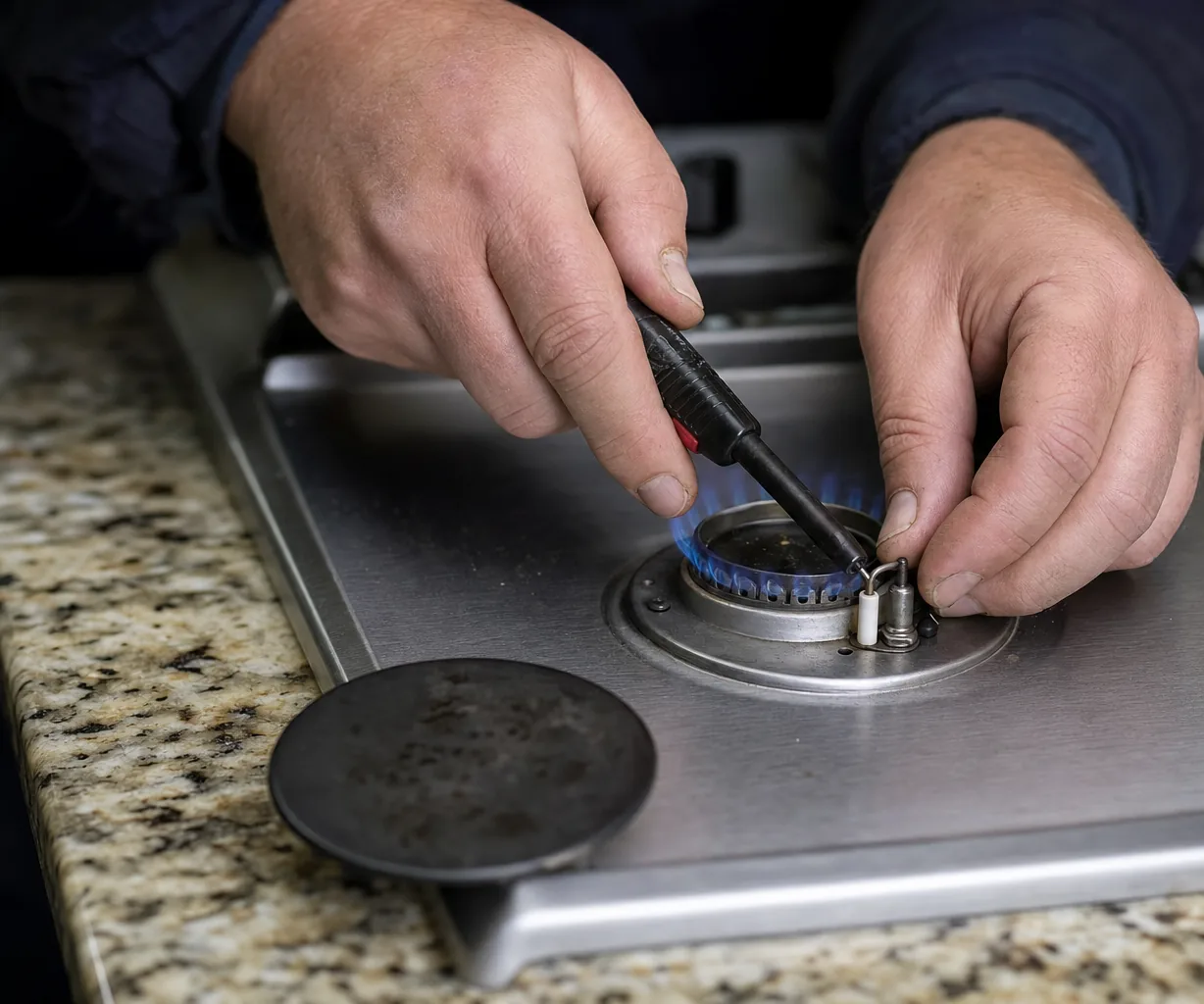
In a Thermador vs Wolf cooktop matchup, Thermador wins on gentle low heat, with a 200 Btu ExtraLow simmer on its 36-inch SGSX365FS gas cooktop, while Wolf wins on peak heat, with a 20,000 Btu large burner on its 36-inch contemporary gas cooktop. Beyond those two numbers the brands are close, so the choice comes down to how you cook, gas or induction, and how the unit fits your White Plains kitchen.
How do Thermador and Wolf gas cooktops compare on burners?
Wolf builds its gas cooktops around dual-stacked sealed burners: an upper ring of ports for high heat and a lower ring that keeps a small, steady flame for simmering. Its 24-inch and 30-inch gas cooktops, plus the 36-inch transitional and professional models, use an 18,000 Btu large burner, a 12,000 Btu medium burner and 9,200 Btu small burners. The 36-inch contemporary model steps the large burner up to 20,000 Btu, and the 15-inch gas cooktop pairs a 12,000 Btu burner with a 9,200 Btu burner.
Thermador’s signature is the star-shaped burner, whose points stretch the flame’s perimeter so heat reaches farther toward the edge of the pan. The 36-inch SGSX365FS runs an 18,000 Btu center Star Burner with two 12,000 Btu and two 9,100 Btu burners on natural gas, a 60,200 Btu total load. Its ExtraLow setting holds a 200 Btu simmer by cycling the flame on and off, gentle enough to melt chocolate without scorching.
| Feature | Wolf gas cooktop | Thermador SGSX365FS (36-inch) |
|---|---|---|
| Largest burner | 20,000 Btu (36-inch contemporary); 18,000 Btu on the other sizes | 18,000 Btu center Star Burner |
| Medium burners | 12,000 Btu | Two at 12,000 Btu |
| Small burners | 9,200 Btu | Two at 9,100 Btu |
| Low-heat method | Lower tier of the dual-stacked burner, a continuous small flame | ExtraLow, 200 Btu by cycling the flame |
At full power the gap is small. The real difference is at the bottom of the dial: Wolf gives a continuous tiny flame, Thermador an ultra-low setting that pulses, so try both in a showroom if you cook delicate sauces.
How do Wolf and Thermador induction cooktops differ?
Wolf’s induction cooktops carry the CI prefix (CG is gas, CE electric and MM the multi-function cooktop) and use marked cooking zones. Thermador’s CIT30YWBB heats across its whole glass surface, detects each pan’s position, size and shape on its own, and runs up to five pieces of cookware at once, which helps with an oval roaster or a long griddle pan.
Both need magnetic cookware: if a refrigerator magnet grabs the bottom of the pan firmly, it will work. The CIT30YWBB also needs a base between 3½” and 13⅛” (90 to 340 mm), so a small espresso pot may not register. Either brand’s induction model needs a dedicated 240-volt circuit, which matters when the cabinet below an old gas cooktop has only a gas line and a standard outlet.
Which brand is more reliable, and what tends to fail?
The reliability gap between these brands is smaller than the gap between gas and induction. Gas models from both are mechanically simple: a valve and spark igniter per burner, a spark module and caps that must sit flat. Induction trades those parts for power electronics, a cooling fan and touch controls, which clean up easily but cost more when a board fails.
| Symptom | Likely cause | What the owner can check | When to call a technician |
|---|---|---|---|
| Igniter keeps clicking after cleaning | Water in the burner base or spark switch | Remove the caps and let it air-dry for a few hours | Clicking continues once dry |
| Burner won’t light or lights unevenly | Cap off-center or clogged ports | Reseat the cap; Wolf’s two-piece cap must sit flat on both tiers | Still fails, or any gas smell |
| Thermador flame pulses on low | ExtraLow cycling, which is normal | Confirm the knob is in the ExtraLow range | Flame drops out at medium or high |
| Induction zone won’t heat | Pan not magnetic or base too small | Magnet test; try a larger pan | A known-good pan still won’t heat |
| Induction shuts off mid-cook | Overheating from blocked airflow | Clear the drawer or cabinet under the vents | It repeats with clear airflow |
If you smell gas, turn the burners off, touch no switch or flame, leave the house and call your gas utility from outside.
What do Thermador and Wolf cooktop repairs typically cost?
Both brands land in the same bands, because the work is similar. Typical ranges in White Plains are $95–$149 for the diagnostic visit, $200–$750 for cooktop repair, $300–$650 for a gas valve or spark module, and $400–$850 for a control board. The firm price is given on site after diagnosis, and the service call is credited toward the repair. See our repair pricing page for the other bands.
How do service and parts compare between the two?
Both are established premium brands with dedicated parts, so a dead igniter or valve on either is a repair, not a reason to replace the cooktop. Have the model and serial number ready; the label is usually under the cooktop, visible from the cabinet below. On Wolf, CG means gas and CI induction, while T, P or C marks Transitional, Professional or Contemporary styling, and a -LP ending marks a liquid propane unit. We work on both brands; read more on our Wolf and Thermador pages, or see how a cooktop repair visit works.
Which should you choose for a White Plains kitchen?
Pick Thermador if steady low simmering matters most or you want full-surface induction. Pick Wolf for the 20,000 Btu contemporary burner, a continuous low flame, or a 15-inch gas cooktop in a modular layout. Many downtown White Plains condos are in high-rise buildings, so ask management whether gas reaches your unit; if not, induction decides it. In older homes in Gedney Farms, Battle Hill or the Highlands, measure the existing cutout and note where the gas line or 240-volt circuit comes up, because cutout sizes differ between brands and models.
White Plains Wolf Appliance Repair is an independent service, not manufacturer-authorized, serving White Plains, Scarsdale, Harrison and Hartsdale. Call (914) 275-0968.
Frequently asked questions
Is Thermador or Wolf better for a gas cooktop?
Neither wins across the board: Thermador’s SGSX365FS is stronger at the low end with a 200 Btu ExtraLow simmer, while Wolf’s 36-inch contemporary model is stronger at the top with a 20,000 Btu burner. Choose by the cooking you do most.
Is Wolf or Thermador better for induction?
Thermador’s CIT30YWBB suits cooks who want to place pans anywhere, since the whole surface heats and it finds each pan on its own. Wolf’s CI models use defined zones that keep each pan’s spot fixed.
Which costs more to repair, Thermador or Wolf?
Repairs fall in the same typical ranges for both, such as $200–$750 for cooktop repair and $300–$650 for a gas valve or spark module. The firm quote is given on site after diagnosis.
How does Wolf compare to Thermador for gas rangetops?
The same burner designs carry over: Wolf’s sealed burner rangetops, marked SRT in the model number, use dual-stacked burners, while Thermador’s pro-style tops use raised star-shaped burners.